

How to Plan a Trip Without Chasing Social Media Hotspots
I still remember standing in a line of about forty people in Bali, all of us waiting our turn on a wooden swing that hangs off a cliff. Everyone wanted the exact same photo legs stretched out, ocean in the background, that one specific angle you’ve seen a thousand times on Instagram.
It took me almost two hours to get five minutes on that swing. When I finally sat down, a staff member yelled instructions at me in rapid-fire English (“point your toes, lean back, smile, next!”) while another guest was already tapping her foot waiting for her turn.
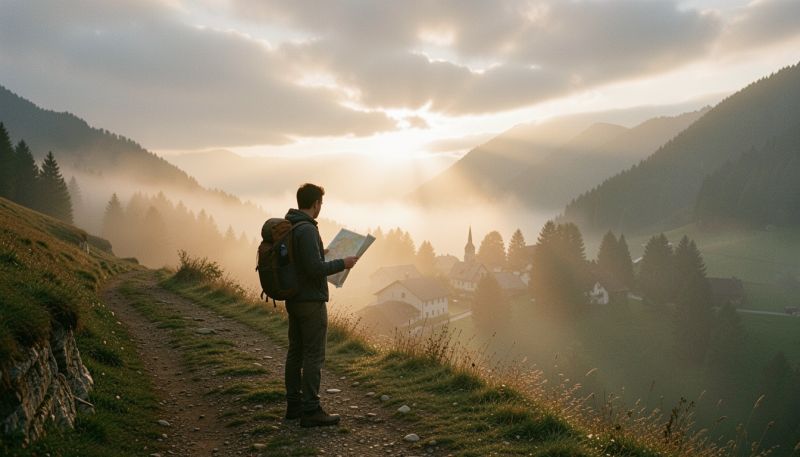
I got the photo. It looked great. It also felt completely hollow.
That trip cost me a decent chunk of my vacation budget, and when I look back at my itinerary now, I realize I spent almost 70% of my time either traveling to “photo spots” or waiting in line for them. I barely remember what the food tasted like. I don’t remember a single conversation with a local person. I remember queues.
I Did 10 Days in Japan for Under $2000 — Here’s Exactly How
That was the trip that changed how I plan travel completely. And honestly, every trip since then has been better cheaper, calmer, and weirdly enough, more “photogenic” too, because I stopped forcing it.
If you’ve ever felt that letdown after finally reaching some viral spot only to find it’s smaller, dirtier, or more crowded than it looked online, this one’s for you.
Why Chasing Hotspots Usually Backfires
Here’s the thing nobody tells you before you go: the photo you saw online is almost never the full picture.
That infinity pool in Bali?
Cropped so you can’t see the ten other people also getting their infinity pool shot three feet away. That “hidden gem” waterfall in Iceland? It has a parking lot now, and a ticket booth. That aesthetic café in Seoul? There’s a 45-minute wait and a strict “one drink per person, 60 minutes max” policy because it’s been posted about so many times.
Social media compresses a location into a single, perfect frame. It cuts out the crowd, the smell of sunscreen and body odor from 200 tourists, the guy selling counterfeit sunglasses, the ropes and barriers, the “no drone” signs, and the fact that you have four minutes before the next tour bus unloads.
None of that is the destination’s fault. It’s just what happens when a place becomes an algorithm’s favorite thumbnail.
There’s also a financial cost to this. Hotspots almost always come with hotspot pricing. Cafés near famous viewpoints charge double.
Tour operators near “Instagram-famous” waterfalls or swings often charge entrance fees specifically because they know people will pay for the picture. I’ve paid $15 for a coconut that would’ve cost $2 a street over, purely because I was standing in a spot that shows up on every “Top 10 Bali Photos” listicle.
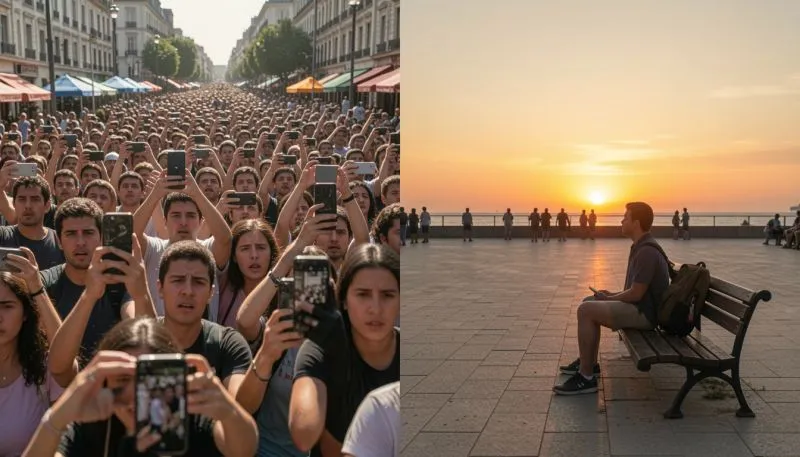
And maybe the biggest cost is the one you don’t notice until later: you didn’t actually experience the place. You experienced a queue, a countdown timer, and a slightly stressed version of yourself trying to get the shot before the next group arrives.
The Shift That Actually Changed My Trips
After Bali, I didn’t swear off nice photos or scenic spots. That’s not the point. The point is I stopped letting a feed decide my itinerary for me.
Instead, I started asking a different question before every trip:
- What do I actually want to feel while I’m there?
- Relaxed? Adventurous?
- Like I actually talked to real people?
- Like I ate food that wasn’t on a “must-try” list curated by someone who spent four hours in that city?
Once I started planning around that question instead of a mental Pinterest board, everything got easier. Fewer decisions, less stress, and this is the funny part better photos anyway, because I wasn’t rushing or fighting for space.
Here’s exactly how I plan trips now, step by step.
Step 1: Figure Out the Vibe Before the Destination
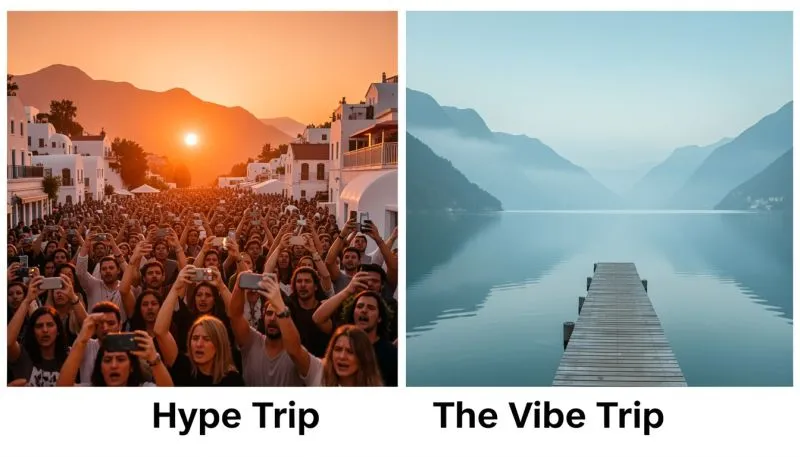
Before I even open a map, I write down three or four words describing what kind of trip I want. Slow and food-focused. Outdoorsy and quiet. Culture-heavy with lots of walking. Beach trip where I don’t move much at all.
This sounds small, but it saves you from the trap of picking a destination because it’s trending, then spending the whole trip trying to force your personality into someone else’s itinerary.
Type of Traveler
For example, I once picked Santorini because, well, everyone picks Santorini. But I’m not really a “watch the sunset with 500 other people at Oia castle” type of traveler. I like quiet mornings and long walks. The trip was fine, but it wasn’t “me.”
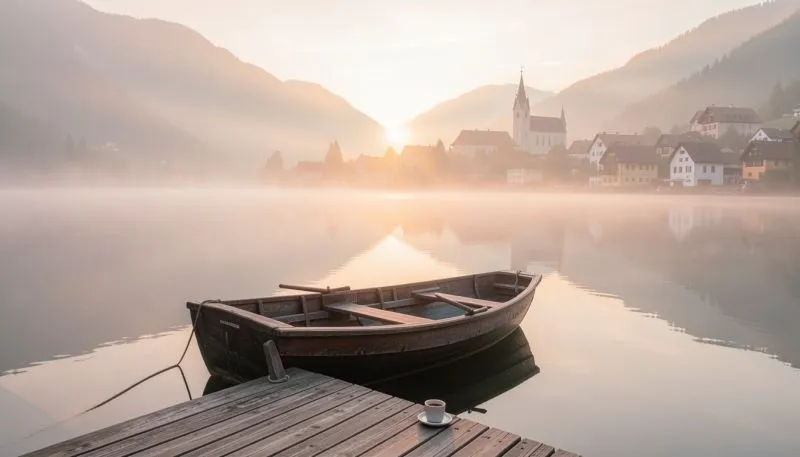
A year later I went to a lesser-known part of Slovenia instead quiet lakes, small towns, way fewer crowds and it fit my actual personality so much better. Same continent, completely different experience, because I planned around vibe instead of hype.
Step 2: Get Your Information From More Than One App
Instagram and TikTok are great for inspiration, but terrible for planning, because they only show you the same 15 spots everyone else is also seeing. If you want a fuller picture, you need to pull from different sources:
- Reddit : search “[destination] travel” in the search bar, or check subreddits like r/travel or city-specific ones (r/Bali, r/JapanTravel, etc). People post real complaints, real budgets, real “don’t waste your time here” warnings.
- Wikivoyage : an old-school but genuinely useful free travel wiki. Boring layout, incredibly practical info.
- Google Maps saved lists : search a city, look at the “reviews” tab sorted by most recent, and read what actual visitors are saying this month, not three years ago.
- Long-form YouTube vlogs : not the 60-second reels, the 15-20 minute ones where someone actually walks you through a full day. You see the waiting, the walking, the weather. Much more honest.
- Local Facebook groups : search “[city] expats” or “[city] travel tips.” Expats living somewhere will tell you which “famous” restaurant is actually a tourist trap and which hole-in-the-wall place down the street is where they actually eat.
I usually spend maybe an hour total across these sources for a week-long trip. Not researching for days just enough to get a realistic sense of the place instead of a filtered one.
Visa-Free Countries for US Passport Holders in 2026
Step 3: Build Your Itinerary Around Time, Not a Checklist
This was probably the biggest mistake I used to make. I’d build a list of 12 “must-see” spots for a 4-day trip, then spend the entire trip rushing between them like I was doing a scavenger hunt.
Now I do the opposite. I pick a home base and figure out how much unstructured time I actually want. As a rough rule, I try to leave at least one half-day per two full days completely unplanned. No destination, no reservation, just walking and seeing what happens.
Some of my favorite travel memories came from that unplanned time. In Chiang Mai, I wandered into a random neighborhood market because I got a little lost, and ended up talking to a noodle vendor for twenty minutes who told me about a temple that wasn’t in any guidebook. It had maybe six other visitors the whole time I was there. That temple didn’t have a hashtag. It had birds, incense smoke, and quiet.
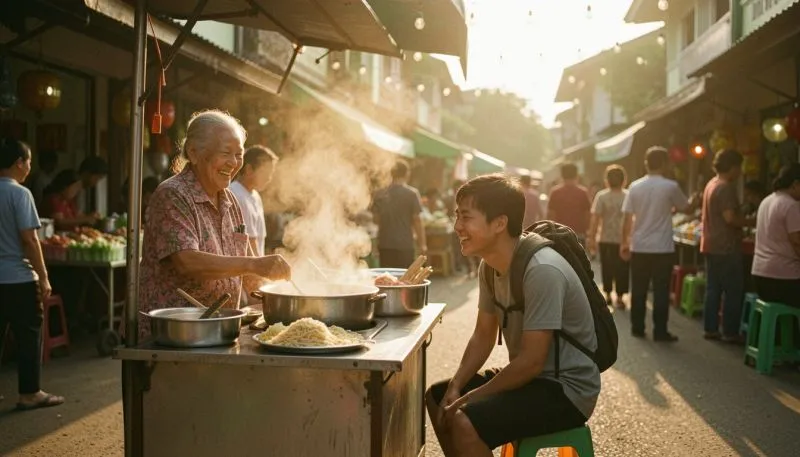
You can’t plan for that kind of moment. You can only leave room for it.
Step 4: Ask, Don’t Just Search
One thing that’s genuinely underrated: just asking people. Taxi drivers, hotel staff, the person running your Airbnb, waiters they usually know the actual good spots, because they live there.
I make it a habit to ask two questions wherever I stay:
- “Where do you go when you want good food and don’t want tourists around?”
- “Is there anywhere nearby that’s beautiful but not really known?”
More than half the time, I get an answer that isn’t on any list. In Lisbon, my Airbnb host told me about a viewpoint two streets from a famous one that had literally the same view with a fraction of the people, because it wasn’t the “official” miradouro that shows up in searches. Same sunset, zero crowd.
Step 5: Use Practical Tools, Not Just Inspiration Ones
Once I know roughly where I’m going and what I want to feel, I switch to the boring-but-necessary apps:
- Google Maps (offline mode) download the offline map for your destination before you land. Saves you from data issues and gets you around even in low-signal areas.
- Rome2Rio or Google Flights for figuring out how to actually get between places, including buses and trains, not just flights.
- Trail Wallet or Splitwise for tracking spending, especially useful if traveling with others and splitting costs.
- Google Translate with the offline language pack downloaded, plus the camera translation feature, which has saved me more times than I can count reading menus.
- XE Currency app for quick conversions so you’re not doing mental math while haggling.
None of these are exciting apps. They’re not going to inspire your next trip. But they’re the difference between a smooth day and a stressful one.
Things to Do in Istanbul for 3 Days
Real Example: Two Trips, Two Totally Different Outcomes
Let me walk you through an actual comparison, because I think it makes the point clearer than just talking theory.
Trip A (Bali, hotspot-chasing mode): Itinerary built almost entirely from a “Top Instagram Spots in Bali” article. Six locations in five days, each requiring 45-90 minutes of travel by scooter or car. Long queues at three of the six. One spot turned out to be temporarily closed for renovation (which no one online mentioned).
- Total cost for entrance fees and “photo packages”: around $140. Overall feeling by day four: exhausted, a little disappointed, and honestly relieved when it was over.
Trip B (Georgia, the country, vibe-first mode): Picked Georgia because I wanted mountains, quiet, and good food, not because it was trending. Spent four nights in Tbilisi and three in a small guesthouse in the Kazbegi region. Didn’t chase any specific “spot” just picked a region known for hiking and let each day unfold.
Ended up doing an unplanned hike to a small church with a view of Mount Kazbek, recommended by the guesthouse owner, with maybe ten other people around instead of two hundred. Total cost for the entire week, including food and a driver for two day trips: less than what I spent on entrance fees alone in Bali. Overall feeling: relaxed, genuinely happy, and I’ve already told at least ten friends to go.
Same amount of vacation days in both cases. Wildly different experiences.
Common Mistakes People Make (I’ve Made Most of These)
Mistake 1: Planning your whole trip around one photo you saw.
It’s fine to have a spot or two you genuinely want to see. Just don’t build your whole itinerary as a checklist of visuals. You’ll spend more time getting the shot than enjoying the place.
Mistake 2: Ignoring the time and cost of getting to “hidden gems.”
A lot of viral “hidden gems” aren’t actually close to anything. I once spent four hours round-trip on questionable roads to reach a waterfall that ended up being smaller than my shower. Always check the actual travel time and road conditions, not just the destination itself.
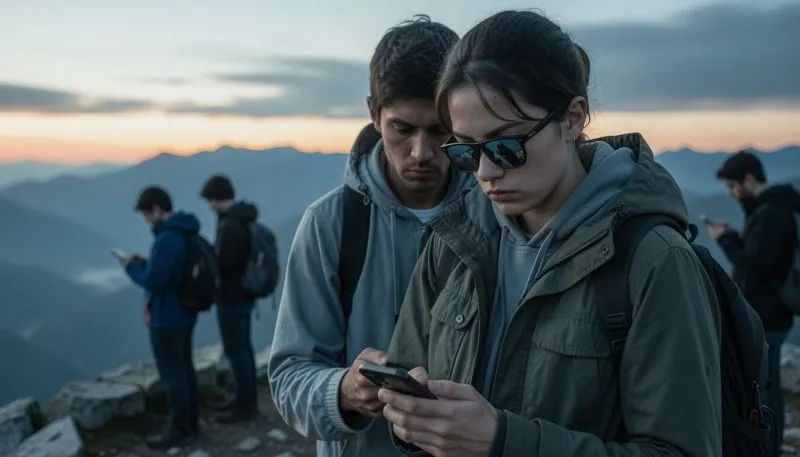
Mistake 3: Traveling during the exact time everyone else does.
If a place is famous for sunrise or sunset, that’s when it’s most crowded. Sometimes showing up two hours earlier or later gives you almost the same view with a fraction of the people.
Mistake 4: Not budgeting slack time.
Overpacked itineraries lead to rushing, which leads to stress, which leads to a trip that feels more like a to-do list than a vacation.
Mistake 5: Trusting only recent trending content.
Trending spots get overrun fast. What looked peaceful in a video from two years ago might now have a fence, a fee, and a 40-minute queue. Always check recent reviews, not just the original post that made it famous.
Mistake 6: Forgetting that locals live there.
Some so-called hotspots are literally someone’s neighborhood. Showing up with a drone, a ring light, and a full camera crew for a photo in a residential area isn’t great etiquette. A little awareness goes a long way.
A Few Small Habits That Make a Big Difference
Over time I’ve picked up a few small habits that keep my trips grounded and less influenced by hype:
I mute or unfollow “top 10 places to visit” accounts a week or two before a trip, just so my feed doesn’t keep dangling more spots at me while I’m trying to plan something simple.
I look at a map of my destination and physically mark out neighborhoods instead of pins for single attractions. Neighborhoods give you room to wander; pins give you a rigid checklist.
I try to book one full day with absolutely nothing planned, especially on longer trips. It sounds counterproductive, but it’s usually the day I remember most.

I ask myself, before booking any “experience,” whether I’d still want to do it if I couldn’t take a photo of it. If the answer is no, that’s usually a sign it’s more about the picture than the place.
Is Turkey Safe to Visit in 2026? Here’s What Nobody Tells You Before You Book
Final Thoughts
None of this means hotspots are evil or that you should avoid every famous place out of principle. Famous places are often famous for a real reason incredible views, historical significance, genuinely good food. Go see them if they matter to you.
The difference is planning your trip around your own curiosity instead of around what performs well on a feed. When you do that, you end up with fewer regrets, fewer crowds, a lighter wallet, and honestly, better stories to tell when you get home. Nobody wants to hear about the two hours you waited in line for a swing. Everybody wants to hear about the noodle vendor who pointed you toward a hidden temple.
Next time you’re planning a trip, try building it around a feeling instead of a feed. It’s a small shift, but it changes almost everything about how the trip actually goes.

Michael James is an American travel writer and Europe visa specialist with 7+ years of experience helping U.S. citizens stay longer in Europe. Through real conversations with digital nomads, retirees, and expat families, he delivers clear, no-fluff guides on the latest 2026 Schengen rules, ETIAS, and the best long-stay visas. Follow his practical advice at TravelTipHub.