

How to Travel Europe on a Budget
The first time I flew into Amsterdam, I had exactly €1,200 in my account, a 35-liter backpack, and a vague idea that I’d “figure it out as I go.” What followed was 28 days across eight countries, some genuinely unforgettable moments and a few nights sleeping on overnight trains not because I wanted the adventure, but because I hadn’t booked accommodation in time and literally couldn’t afford a last-minute hostel.
I came back with stories, a mild train-seat neck injury, and a deeply practical understanding of what “budget Travel Europe” actually means versus what the Instagram highlights reel makes it look like.
Here’s what I actually learned not theory, not listicle filler, but the real mechanics of seeing Travel Europe well without hemorrhaging money.

First, Let’s Kill the Myth That Budget Travel Means Missing Out
People assume that if you’re not staying at boutique hotels or eating at restaurants where the menu doesn’t have prices, you’re somehow getting a lesser version of Travel Europe. That’s just not true.
The Eiffel Tower looks the same from the Trocadéro (free viewing) as it does from the paid summit. The canals in Venice are exactly as beautiful from a €1.50 vaporetto as from a €120 gondola. The food at a market stall in Barcelona? Often better than the tourist-trap tapas places that translate their menu into six languages.
Budget travel isn’t about deprivation. It’s about being intentional with where money goes and ruthless about what’s actually overpriced for what you get.
Planning: The Work You Do Before You Leave Saves You the Most Money
I used to think spontaneity was the soul of travel. And while it has its place, showing up to Prague on a Friday night in July without a bed booked because you “felt like it” will cost you three times what it would have cost with two weeks’ notice. I speak from experience.
Start with a route, not a wishlist.
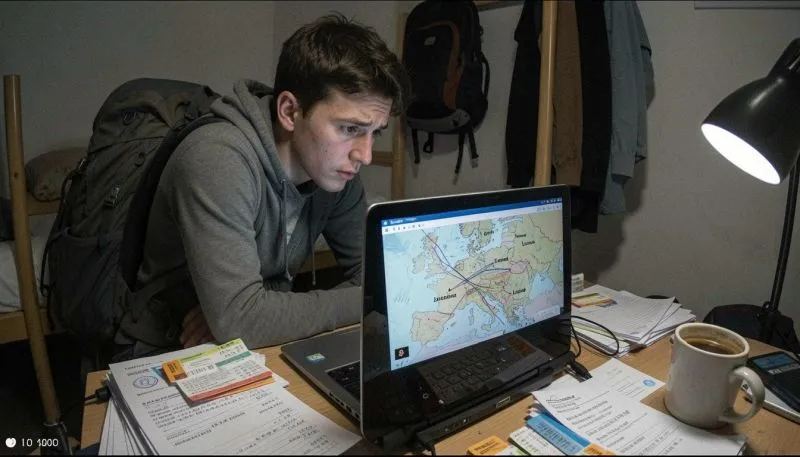
The biggest money drain most first-time Travel Europe backpackers don’t see coming is the cost of fixing bad routing. Flying from London to Rome, then deciding you want to see Amsterdam, then hopping to Lisbon — you’re paying for that chaos in airfare and wasted time. Spend a weekend before you leave sketching out a rough geographic flow.
ETIAS Visa Tips for USA Citizens: Your Complete 2026 Guide to Smooth Europe
Tools I’ve actually used for this:
- Google Maps in “directions” mode just drag pins across a continent to see travel distances
- Rome2Rio underrated app that shows every possible way to get from A to B, including costs
- The Man in Seat 61 (seat61.com) sounds old-fashioned, but it’s the most detailed resource on Travel Europe train travel that exists
Book accommodation for the first and last nights at minimum. The middle can stay flexible. But arriving in a new city at 11pm without somewhere Travel Europe confirmed is when you end up spending €85 on the only available hostel private room because all the dorms are full.
Getting Around Travel Europe: The Real Cost Breakdown
This is where most travel budgets actually go off the rails, and where the biggest savings live.
Budget Airlines: Actually Useful If You Use Them Right
Ryanair, Wizz Air, EasyJet these carriers get a bad reputation, and honestly, some of it is fair. The legroom is punishing, the upselling is aggressive, and if you show up with a bag that’s 1cm too wide they will charge you at the gate with the energy of someone who has been waiting their whole career for this moment.
But: a €9 flight from Berlin to Kraków is a €9 flight from Berlin to Kraków. You just have to play by the rules.
The rules:
- Only take what fits in the free personal item (typically 40×20×25cm this fits more than you think if you pack well)
- Download the app and use mobile boarding passes printing fees are real and petty
- Search Google Flights first, then go directly to the airline’s site to book (Google Flights shows Ryanair fares but sometimes the airline’s own site is a few euros cheaper)
- Book Tuesday or Wednesday mornings this is genuinely when fare drops happen most often
The mistake I made my first trip: I bought a €15 Ryanair bag fee “just in case” for a flight I didn’t end up needing it for, then paid another €25 at the gate on the return because I’d impulse-bought a small painting in Prague and my bag was suddenly too big. €40 evaporated just like that.
Trains: Cheaper Than You Think If You Know When to Book
Interrail (for Travel Europe) and Eurail (for everyone else) passes get marketed heavily and are sometimes worth it, but often aren’t. A pass makes sense if you’re moving every 1–2 days across multiple countries. If you’re staying somewhere for 3–4 days at a time, individual tickets are almost always cheaper.
The Trenitalia app (Italy), DB Navigator (Germany), and SNCF Connect (France) all sell advance-purchase tickets at significant discounts. A Paris–Lyon TGV that costs €89 on the day can be €19 booked three weeks out.
- Overnight trains are genuinely underrated. A 9-hour overnight from Vienna to Venice, for example, can cost €30–50 in a couchette. You travel, you sleep, you arrive, you’ve saved a night of accommodation. The economics are just good.
Buses: Slow, But Sometimes the Right Answer
FlixBus connects virtually everywhere in Travel Europe and is usually cheaper than trains. The trade-off is time a 4-hour train becomes an 8-hour bus. But if you’re flexible, doing it overnight, or going somewhere trains don’t reach well, it’s a solid option. I’ve done the London to Paris FlixBus for £15. It’s not glamorous. It works.
Digital Nomad Visa Guide – Which Countries Allow Easy Stay in 2026
Accommodation: Where to Save Without Destroying Sleep Quality
I’ve stayed in hostels across the continent, and here’s the honest truth: the quality range is enormous. A bad hostel is a nightmare of snoring, theft anxiety, and a bathroom situation you’re trying to forget. A good hostel is genuinely one of the best parts of solo travel social, clean, and full of people who are also figuring out where to go for dinner.
The Platforms I Actually use:
- Hostelworld for hostels specifically the review system is detailed and honest
- Booking.com for a broader search including guesthouses and small hotels
- Couchsurfing yes, still exists, and if you put real effort into your profile and reach out thoughtfully to hosts, it can lead to genuinely remarkable experiences. It’s not a free accommodation hack; it’s a cultural exchange that happens to involve a free bed.
The features worth paying slightly more for in a hostel:
- Lockers with actual charging points inside them
- Reading lights per bunk (sounds minor, it isn’t)
- En-suite bathrooms or a decent ratio of bathrooms to beds
- Air conditioning or a fan if you’re traveling in summer southern Travel Europe in July without AC in a dorm is survivable but unpleasant
One thing I stopped doing: booking hostels with “no refund” policies more than a week in advance. Plans change, and a non-refundable dorm bed in Ljubljana that you end up not using because you stayed an extra day in Vienna is just money gone.
Food: The Biggest Variable in Any Travel Budget
You can eat in Paris for €8 a day or €80 a day. The version that costs €8 is not a sad one.
The actual strategy:
- Lunch is when you eat your main meal in any Travel Europe city. Most restaurants offer a fixed-price “lunch menu” — in Spain it’s called the menú del día, in France the formule that includes multiple courses for €10–15. The same meal at dinner would be €30+.
- Supermarkets are not a failure. They are breakfast and one meal a day, and they let you eat local food (cheese, bread, charcuterie, fruit) that’s genuinely delicious. Lidl and Aldi are everywhere and their quality is solid.
- Markets over restaurants for snacking. Borough Market in London, La Boqueria in Barcelona, Naschmarkt in Vienna these are destinations in themselves, and eating a sandwich and a piece of cheese while sitting on a step watching the city move is peak travel eating.
The thing that kills food budgets: treating every meal as a photogenic event. Having one exceptional restaurant dinner every third or fourth day is perfectly sustainable and still gives you the experience. Doing it every meal is where the money vanishes.
Free and Cheap Experiences: The Ones That Are Actually Good
Here’s something that took me a few trips to internalize: the best things in Travel Europe are mostly free or nearly free.
What’s actually free in most major Travel Europe cities:
- Nearly all major art museums on the first Sunday or one day a week (the Louvre, the Prado, the Rijksmuseum check dates before you go)
- Every major cathedral, unless there’s a specific paid attraction inside (climbing the dome, viewing the treasury)
- Walking the old town of virtually any Central or Eastern Travel Europe city Krakow, Tallinn, Ljubljana, Prague which are architectural museums you just walk through
- Public beaches in Croatia, Greece, and southern France
- Street food festivals, outdoor concerts, and local markets that happen constantly all summer
The Paid Experiences Worth Paying for:
- A day trip that gets you out of the tourist core. A train ride to Cinque Terre from Florence, the Blue Lagoon in Iceland (ok, not cheap, but truly exceptional), a boat trip to the Plitvice Lakes in Croatia. The things that require effort to reach are almost always less crowded and more memorable.
- Skip-the-line tickets for the one or two things you’ve genuinely always wanted to see. Standing in a three-hour queue at the Colosseum or the Sagrada Família is not saving money it’s spending half your day standing still. Pre-book, budget for it, don’t regret it.
The Apps and Tools I Actually Used
No fluff here — these are the things open on my phone on a regular basis:
- Google Maps offline download the offline map before you land. Data roaming or dead spots won’t kill you.
- Revolut or Wise a card that converts currency at the interbank rate with no foreign transaction fees. This is non-negotiable if you’re crossing multiple countries. ATM fees and bad conversion rates will silently eat your budget otherwise.
- Citymapper better than Google Maps for navigating public transit in cities. Tells you which door to stand near. Sounds excessive. Is useful.
- TooGoodToGo app where restaurants and bakeries sell their end-of-day surplus at massive discounts. Got a bag of pastries in Copenhagen for €3 that would have cost €18 at retail. Highly recommend.
- XE Currency quick exchange rate check before any big purchase
- Skyscanner for flexible date flight searching; the “whole month” view shows you which days are cheapest
Common Mistakes I Made (So You Don’t Have To)
- Underestimating transport within cities. I’d budget for inter-city travel but not think carefully about the metro, trams, and buses once I got somewhere. A city like London or Zurich can easily add €15–20 a day just in local transport if you’re not buying a daily or weekly pass.
- Going to Western Travel Europe first. If budget is a genuine constraint, starting in Eastern or Central Travel Europe (Poland, Czech Republic, Hungary, the Balkans) gives you a much softer landing. The culture is rich, the food is excellent, the costs are about 40–60% of Western Travel Europe. Come back west once you’ve got your legs.
- Not checking free museum days in advance. I paid full price for the Uffizi in Florence because I didn’t know the first Sunday of the month was free. That’s a €20 lesson.
- Packing too much. I know everyone says this, but I still overpacked my first trip. Overpacking means checked bag fees, slower movement, and carrying too much weight through cobblestone streets in August heat. Everything you pack, ask: would I pay €15 to have this in my bag? Because that’s roughly what an extra bag costs you in fees.
- Booking everything too far in advance. There’s a sweet spot. Six weeks out for accommodation is usually good. Three months out for peak summer in places like Santorini or the Amalfi Coast. But booking every activity and every meal the moment you plan the trip removes flexibility that often leads to the best experiences.
The Ultimate Solo Travel Packing List for Europe 2026

A Rough Numbers Breakdown
For context: doing Travel Europe properly on a budget in 2024–2025 typically looks something like this per day, depending on region:
| Region | Daily Budget (Comfortable Budget) |
|---|---|
| Western Travel Europe (Paris, Amsterdam, London) | €70–90/day |
| Central Travel Europe (Prague, Vienna, Krakow) | €45–65/day |
| Eastern/SE Travel Europe (Budapest, Bucharest, Balkans) | €30–50/day |
| Scandinavia | €90–120/day |
These include accommodation (hostel dorm or budget guesthouse), food, local transport, and a couple of paid activities. If you’re cooking some of your own food and being selective about activities, you can come in 20% lower. If you’re doing everything spontaneously and eating at tourist restaurants, you’ll be 30–40% higher.
What Budget Travel Europe Actually Feels Like
I want to be honest about this because sometimes the budget travel framing makes it sound relentlessly stressful.
It isn’t. Or it doesn’t have to be.
Some of the best moments from that first trip getting talking to a Scottish couple on a night train to Budapest, stumbling into a free outdoor jazz festival in Lyon, eating a €3 bánh mì from a Vietnamese takeaway in Prague’s Žižkov neighborhood at midnight because the hostel owner recommended it none of those cost anything or required planning.
The infrastructure work (transport, accommodation, a rough route) just creates the conditions for those things to happen. The actual travel the wandering, the eating, the talking to strangers, the sitting in a square watching people is free everywhere.
How to Travel Solo Safely as a Beginner
You don’t need a big budget to see Travel Europe well. You need a bit of planning, a willingness to eat lunch as your main meal, a card that doesn’t charge foreign transaction fees, and the sense to book accommodation more than twelve hours in advance.
Everything else tends to work itself out.

Michael James is an American travel writer and Europe visa specialist with 7+ years of experience helping U.S. citizens stay longer in Europe. Through real conversations with digital nomads, retirees, and expat families, he delivers clear, no-fluff guides on the latest 2026 Schengen rules, ETIAS, and the best long-stay visas. Follow his practical advice at TravelTipHub.