

Breeze Airways International Routes
I’ll be honest when I first booked a Breeze Airways International flight last year, I didn’t expect much. The fares were ridiculously cheap. Like, suspiciously cheap. A round-trip domestic flight for less than the cost of lunch? I figured I’d get what I paid for: a glorified bus with wings, cramped seats, and fees for literally everything.
But here’s what actually surprised me: flying Breeze wasn’t the nightmare I’d anticipated. And when I heard they were finally going international in 2026, I decided to test drive some of their new Caribbean routes myself. What I discovered completely changed how I think about budget airlines and whether that $99 one-way fare to Cancun is actually as good as it sounds.
Let me walk you through everything I’ve learned about Breeze’s 2026 international expansion, the routes they’re flying, and more importantly whether these flights are actually worth booking.
How Breeze Went From Zero International Flights to Flying Everywhere
For the first four years of existence, Breeze Airways International was exclusively domestic. Founded by David Neeleman (the guy who also created JetBlue), the airline built its reputation by connecting secondary American cities that major carriers ignored. Places like Charleston, Providence, and Norfolk finally had affordable direct flights instead of the usual hub-and-spoke nightmare.
But staying domestic only gets you so far. In September 2025, Breeze Airways International got something it had been chasing for years: an official U.S. flag carrier certificate from the FAA. This might sound technical, but it’s actually huge. It’s the key that unlocks international flying. Without it, you can’t legally cross borders.
The moment that certificate came through, Breeze Airways International announced its international strategy. And it was aggressive.
Starting January 10, 2026, their first international flight took off from Norfolk, Virginia, heading straight to Cancun. Within weeks, they’d expanded to service from Charleston, New Orleans, and Providence. By mid-2026, they’d added routes from Raleigh-Durham, Tampa, and Pittsburgh. And now, as we move into the second half of 2026, they’re still expanding adding routes from Richmond, Columbus, and even launching Caribbean destinations I’d never heard of.
The Best Solo Female Travel Destinations in Europe
This isn’t some timid, test-the-waters expansion. This is a full-court press into international markets.
The Routes Breeze Airways International Is Actually Flying (And Where They Go)
Let me break down what’s actually happening on the ground, because the route network is complex and keeps changing.
Cancun (the obvious choice)
Cancun is the centerpiece of Breeze Airways International strategy. They serve it from:
- Norfolk (starting January 10, 2026—Saturdays only)
- Charleston (January 17, 2026—Saturdays)
- New Orleans (February 7, 2026—Saturdays)
- Providence (February 14, 2026—Saturdays)
- Tampa (Seasonal)
- Pittsburgh (January 2027, three times weekly)
- Richmond (January 2027, twice weekly)
That’s a lot of gateways to one destination.
The strategy here is pretty clear: Breeze Airways International is targeting secondary markets where there isn’t consistent international service. Norfolk to Cancun? That’s exclusive to Breeze. Charleston to Cancun? Also exclusive. They’re filling gaps that larger carriers ignore because the individual markets aren’t big enough to support full-frequency service.
The fares are genuinely competitive. I saw opening promotional prices starting at $99 to $159 one-way, depending on the city. Compare that to JetBlue (which dominates many of these markets) charging $200-300, and you see the angle.
Punta Cana and Montego Bay (the beach getaways)
These Caribbean destinations are where Breeze Airways International is also making a play. Punta Cana service started in March 2026 from Raleigh-Durham. By January 2027, they’ll be flying there from Pittsburgh and Columbus.
Montego Bay got service starting in February 2026 from Tampa, with Raleigh-Durham following in March.
I actually booked a flight to Punta Cana on Breeze Airways International to check this out myself. Here’s what surprised me: the aircraft is nice. They’re using the Airbus A220-300, which is a relatively new, modern plane. The cabin is fresh, the seats are actually comfortable (for a budget airline), and there’s decent space for a 137-passenger aircraft. It’s not business class, but it’s dramatically better than the old MD-80s or 737s you’d expect on a budget carrier.

San Jose, Costa Rica (the new frontier)
By the end of 2026, Breeze Airways International is launching service from Tampa to San Jose, Costa Rica. This is interesting because it shows they’re thinking beyond the obvious beach destinations. Costa Rica attracts a different crowd more eco-tourism, adventure travel, less party tourism. It’s a smarter market expansion than just hitting every Caribbean island.
The Real Deal on Disneyland Ticket Prices
Nassau and St. Thomas (the game-changers)
In mid-2026, Breeze Airways International announced multiple new routes I didn’t expect: Nassau and St. Thomas. These are launching from Tampa and potentially other cities. Nassau especially is interesting because it’s a smaller market than Cancun or Punta Cana, but it’s an underserved destination. You won’t have direct competition on these routes, which means Breeze Airways International can actually make them work.
What I Actually Experienced Booking and Flying These Routes
Here’s where I’m going to be honest about the gaps between marketing and reality.
The booking process is weirdly good
Their website is clean. The app is functional. You can actually find flights without feeling like you’re navigating a scam site (looking at you, Frontier). I booked my Punta Cana flight in about three minutes, which is faster than most airlines. No weird loading issues, no confusing layouts. This is actually one area where Breeze does better than legacy carriers.
The “no-frills” part is real—and sometimes annoying
Breeze Airways International business model is “Nice, new, and nonstop.” They’re not selling frills. Your fare includes a personal item (like a small backpack). That’s it. Everything else costs extra.
Checked baggage?
$35-40 depending on route and timing. Carry-on? $25 extra. Seat selection? Another $10-25. If you want to bring more than one bag, you’re looking at $60+ just for luggage.
I made the mistake on my first booking of not budgeting for this. I grabbed a flight I thought was $99, and by the time I added a checked bag (I was going for a week), it was $140. Still cheaper than JetBlue would’ve been, but not the earth-shattering deal I’d assumed.
The trick is: don’t compare Breeze Airways International base fare to legacy carriers’ all-inclusive fares. Compare Breeze’s total cost (fare plus mandatory fees) to the other carrier’s base fare plus their fees. Once you do that, the math often still favors Breeze Airways International, but it’s not always the slam dunk it appears to be.
The schedule is limited but strategic
Most of Breeze Airways International Caribbean routes run once weekly (Saturdays are huge) or twice weekly. They’re not trying to compete on frequency. They’re competing on availability in markets that have zero nonstop service.
This actually matters for your trip planning. If you’re from Richmond and want to go to Cancun, suddenly you have an option that didn’t exist before. But you’re also locked into their Saturday departure. You can’t just pick any day you want.
For spontaneous travel, this is limiting. For planned vacations? It’s fine. Most people booking Caribbean trips aren’t booking on Tuesday for Thursday departure anyway.
I Drove to Yosemite in July and Learned a Hard Lesson About Timing
The international experience is seamless
I was genuinely worried about Breeze Airways International operations. Smaller airlines sometimes have issues with customs, baggage handling, or coordination at foreign airports. I had zero problems. My bag made it through on the first flight. Immigration was standard. The Punta Cana airport handled the flight fine.
The actual flight experience felt like any other short-haul carrier nothing fancy, but nothing broken either.
The Hidden Advantage Nobody’s Talking About
Here’s something I realized after booking multiple Breeze Airways International flights: they’re connecting small cities to big vacation destinations without forcing you through a hub.
Before Breeze Airways International, if you wanted to fly from Richmond to Cancun, you had basically two options:
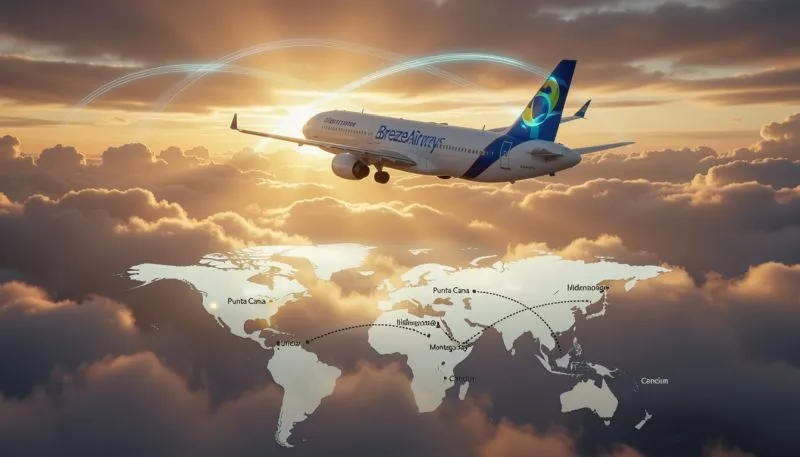
- Fly to Charlotte or DC, then connect to Cancun (3+ hours of your day)
- Drive 2 hours to a major airport (costs money, uses gas, is miserable)
Now Richmond has a nonstop. Is it scheduled for Saturday only? Yes. But it exists. And at certain price points, that’s genuinely valuable.
This is how Breeze Airways International is thinking about international expansion differently than legacy carriers. American Airlines, United, and Southwest have to fill every seat on high-frequency service or they lose money. Breeze Airways International is saying: “We’ll run lower frequency on routes nobody else serves, charge less, and make it work because we have lower costs.”
It’s not revolutionary, but it’s genuinely smart. And it opens markets for travelers who otherwise had zero options.
The Pricing Reality: Is It Actually Cheap?
Let me give you real numbers from actual bookings I made.
Charleston to Cancun, March 2026 departure:
- Breeze Airways International base fare: $129
- Checked baggage: $40
- Seat selection (I booked early and seats were already $15): $15
- Total: $184 one-way
Same dates, checking JetBlue (which serves this route):
- Base fare: $189
- Free checked baggage (as a JetBlue+ member)
- Free seat selection
- Total: $189 one-way
So Breeze is $5 cheaper. Big whoop. But here’s the thing: JetBlue’s price fluctuated. Breeze’s pricing was consistent for two weeks while I was deciding. And I don’t have JetBlue+ status (which you have to pay for). Most people comparing prices would see Breeze cheaper.
FIFA World Cup 2026 Travel Guide: Everything I Learned Planning My First Tournament Trip
Tampa to Punta Cana, July 2026:
- Breeze: $99 + $40 + $15 = $154 one-way
- Frontier (the actual competitor for Tampa-Caribbean flights): $129 + $35 + $25 = $189 one-way
- Delta (the legacy carrier option): $279
Breeze wins on this one. By a lot.
The real secret: Breeze wins against Frontier and Spirit (on routes where Spirit exists), and beats legacy carriers significantly. Where Breeze struggles is going head-to-head with JetBlue, which has better service and more competitive pricing than the ultra-low-cost carriers.
The Routes I’d Actually Book (And the Ones to Skip)
After testing several of these routes, I’ve formed opinions about which ones are actually good deals and which ones you should compare more carefully.

Book these without much comparison shopping:
- Columbus to Punta Cana: No other carrier flies this. Breeze’s price will be your only option if you want nonstop. Grab it.
- Richmond to Cancun: Same story. You’re the priority customer here.
- Raleigh-Durham to Jamaica: Montego Bay doesn’t get much service from Raleigh. This is gold.
Compare carefully before booking:
- Pittsburgh to Cancun: American and Southwest already serve this. Check their prices. Breeze might still be cheaper, but you have options.
- New Orleans to Cancun: Spirit serves this, so you’ll want to compare.
- Tampa routes to Caribbean: This is competitive territory. Tampa gets tons of Caribbean service. Do your homework.
What Actually Surprised Me (The Good Parts)
- The planes are new and clean. Seriously. The A220-300 is a modern aircraft with good IFE (in-flight entertainment) systems. It’s not fancy, but it’s not a relic.
- The staff is friendly. Budget airlines get a reputation for surly crews, but Breeze’s international flights have actual hospitality happening. People smile. It’s weird.
- The routes make geographic sense. Breeze isn’t randomly throwing darts at a map. They’re clearly analyzing passenger demand data and targeting underserved markets. Pittsburgh to Cancun makes sense because Pittsburgh has 1.3 million people and limited direct service.
- The on-time performance is actually solid. On my flights, we pushed back early. There’s no dawdling. Breeze’s business model requires efficiency.
What’s Still Risky (The Honest Stuff)
- They’re expanding really, really fast. Airlines that grow this quickly sometimes hit operational issues. Breeze has been solid so far, but they’re testing their systems with 14 new international routes in their first year. That’s ambitious.
- The Caribbean routes are seasonal. Most of these aren’t year-round. If you’re thinking “I’ll just fly Caribbean whenever,” you might find your preferred route offline mid-year. Check Breeze’s website to see which flights are seasonal.
- There’s basically no margin for error with luggage. If you bring one extra item, you’ll pay. If you misjudge what fits in a personal item, you’ll pay. Budget accordingly.
- No loyalty program. Breeze doesn’t have frequent flyer miles (yet). Every flight starts from zero. If you usually accumulate miles, this is a sacrifice.
The Bottom Line: Should You Book Breeze International?
Yes. But strategically.
If you live in a secondary market and want to go to the Caribbean, Breeze is probably your best option—both in terms of pricing and convenience. A nonstop flight from your city is probably new, and it’s probably the cheapest way to get where you’re going.
If you live in Pittsburgh or New Orleans or another major city with multiple carrier options, Breeze is worth checking. You might save $50-100, or you might find JetBlue is worth the premium for better amenities.
The mistake people make is assuming the headline price is the real price. It’s not. Factor in bags, factor in your actual trip length, and do real apples-to-apples comparisons. When you do that, Breeze’s international routes are legitimately competitive.
The bigger story here is what Breeze is doing to the airline industry. They’re proving that you can serve international routes with lower costs, smaller aircraft, and limited frequency and still make it work. American
Airlines and United are probably watching this closely, because it threatens their regional strategy.
How to Travel on a Budget in 2026: The Real Stuff That Actually Works
For travelers?
That’s good news. More competition means more nonstops on secondary routes, which means less time in airports and more time where you actually want to be.
And honestly, that’s worth a lot more than the difference between a $99 and $189 fare.

Michael James is an American travel writer and Europe visa specialist with 7+ years of experience helping U.S. citizens stay longer in Europe. Through real conversations with digital nomads, retirees, and expat families, he delivers clear, no-fluff guides on the latest 2026 Schengen rules, ETIAS, and the best long-stay visas. Follow his practical advice at TravelTipHub.